| Names | |
|---|---|
| English | den-den |
| Japanese | でんでん |
| Japanese | デンデン |
| Properties | |
| Articulation | hit |
| Shake Length | 2 |
| Parent Techniques | |
| Difficulty | easy |
| Prevalence | core |
| Position | |
| Start | flip position |
| End | flip position |
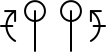
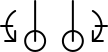
| Glyph Notation | |
| Glyph (down) | |
| Glyph (up) | |
| Usage | |
| Dynamics | |
| Volume | medium |
| Range | high |
| Ease | medium |
| History | |
| Source | unknown |
| Location of Origin | West Africa |
| Date of Origin | unknown |
| Influences | n/a |
| Signature Players | n/a |
Rotate the wrist from side-to-side, letting the free gourd hit the held gourd.
This relies solely on the rotation of the wrist, without a shake motion.
Keep the string of the asalato perpendicular to the hand when swinging. This means enough energy in the rotation of the wrist must be used for a clear, resonant sound.
None yet.
The Japanese name is derived from the den-den daiko, a Japanese pellet drum which is played with a similar motion to this technique.